Circular Economy • Product Strategy • Mobile MVP • Service Design
Turning cosmetic packaging waste into a rewarding circular habit
A sustainability startup needed to make responsible cosmetic-packaging disposal simple enough to become a repeatable consumer habit — while creating measurable value for retail and waste-management partners.
- ✓Defined an end-to-end circular service connecting consumers and partners
- ✓Turned a complex disposal process into a guided mobile journey
- ✓Made environmental impact visible and personally meaningful
- ✓Created a testable MVP for customer and partner validation
Sustainability startup building a circular beauty ecosystem
Motivate correct packaging disposal while validating every return
Product discovery · Service design · UX architecture · MVP design
A customer-ready prototype linking verified returns to loyalty rewards
Outcome first
Business Outcomes
The MVP translated a broad sustainability ambition into a service model the business could explain, test, and evolve with consumers and commercial partners.
Created a credible behaviour loop
The experience connects one clear action — returning packaging — to immediate proof of impact and a tangible reward.
Made partner value visible
Coupons create a reason for beauty brands and retailers to participate while encouraging customers to re-engage.
Reduced validation risk
Product and collection-point scanning establish a traceable event before points are awarded.
Focused the first investment
The prototype defined the smallest coherent experience needed for customer validation and partnership conversations.
The business problem
The Challenge
Cosmetic packaging often combines small formats, mixed materials, and unclear disposal guidance. Even motivated consumers can struggle to understand what is eligible, where it belongs, and whether their effort creates a meaningful result.
For the business, the opportunity depended on more than an attractive app. The service had to connect consumer action, product identification, physical collection points, waste measurement, loyalty economics, and partner-funded rewards in one believable system.
The MVP therefore needed to make a multi-party operational model feel like one simple customer journey without hiding the controls required to keep rewards and impact claims trustworthy.
"A circular service becomes valuable when the sustainable action is easy, verifiable, and worth repeating."
Returning empty packaging competes with the easier default of household disposal.
Points require confidence that an eligible item reached an approved collection point.
Consumers, cosmetics partners, and waste operators each need a clear benefit.
The first release had to prove the service loop without overbuilding the ecosystem.
Framing
Discovery & Product Definition
Discovery mapped the business requirements, user motivations, physical handoffs, and information needed to move from an empty cosmetic package to a verified and rewarded return.
The reward could initiate interest, but proof of personal impact was what made the action feel meaningful rather than purely transactional.
Combining a verified return, visible waste reduction, and redeemable value created a stronger loop than any of those elements could create alone.
Business Model Mapping
Connected consumer participation, partner discounts, collection operations, and measurable packaging recovery.
User Need Assessment
Focused the journey on low effort, clear instructions, immediate confirmation, and visible progress.
Service Blueprint
Defined what the user sees and what the service must verify at each physical and digital handoff.
MVP Definition
Prioritised scanning, drop-off confirmation, impact feedback, points, and coupons as one testable loop.
Product strategy
Key Product Decisions
The product was organised around a small set of decisions that balanced behavioural motivation with operational credibility.
Use two scans to validate one return
Scanning both the packaging and the collection point links an eligible item to an approved physical destination before value is issued.
- ✓Clear responsibility at each step
- ✓Stronger reward integrity
- ✓A traceable return event
Show impact immediately after completion
A successful return should resolve with more than points. Translating package weight into waste diverted gives the action personal meaning.
- ✓Stronger emotional reinforcement
- ✓Visible sustainability progress
- ✓A reason to repeat the behaviour
Connect impact to partner rewards
Redeemable coupons make the service commercially useful to participating brands while giving users a practical benefit they understand instantly.
- ✓Clear partner proposition
- ✓Repeat engagement
- ✓A foundation for reward economics
Keep the MVP journey explicitly guided
The service crosses digital and physical contexts, so numbered steps, completion states, and clear next actions reduce uncertainty at the collection point.
- ✓Lower first-use friction
- ✓Fewer incomplete returns
- ✓Better customer validation
Circular service architecture
Defining the Return-to-Reward Loop
The product turns a complex partner ecosystem into five understandable customer moments, each with a clear action and outcome.
Scan Packaging
Validate Material
Confirm Drop-off
Record Impact
Redeem Reward
One continuous loop from responsible disposal to measurable impact and renewed engagement.
Connecting digital and physical moments
Exploring the Service Experience
The exploration focused on where confidence could break: identifying the right packaging, finding and validating a collection point, understanding completion, and seeing what the return unlocked.
- 01Identify
- 02Validate
- 03Drop off
- 04Measure
- 05Reward
Keep instructions immediate
Users need to understand what to prepare and scan while standing at a physical collection point.
Make completion unmistakable
Clear states confirm that both the product and destination have been accepted.
Close the motivation loop
Impact and rewards need to appear as one coherent outcome, not disconnected app features.
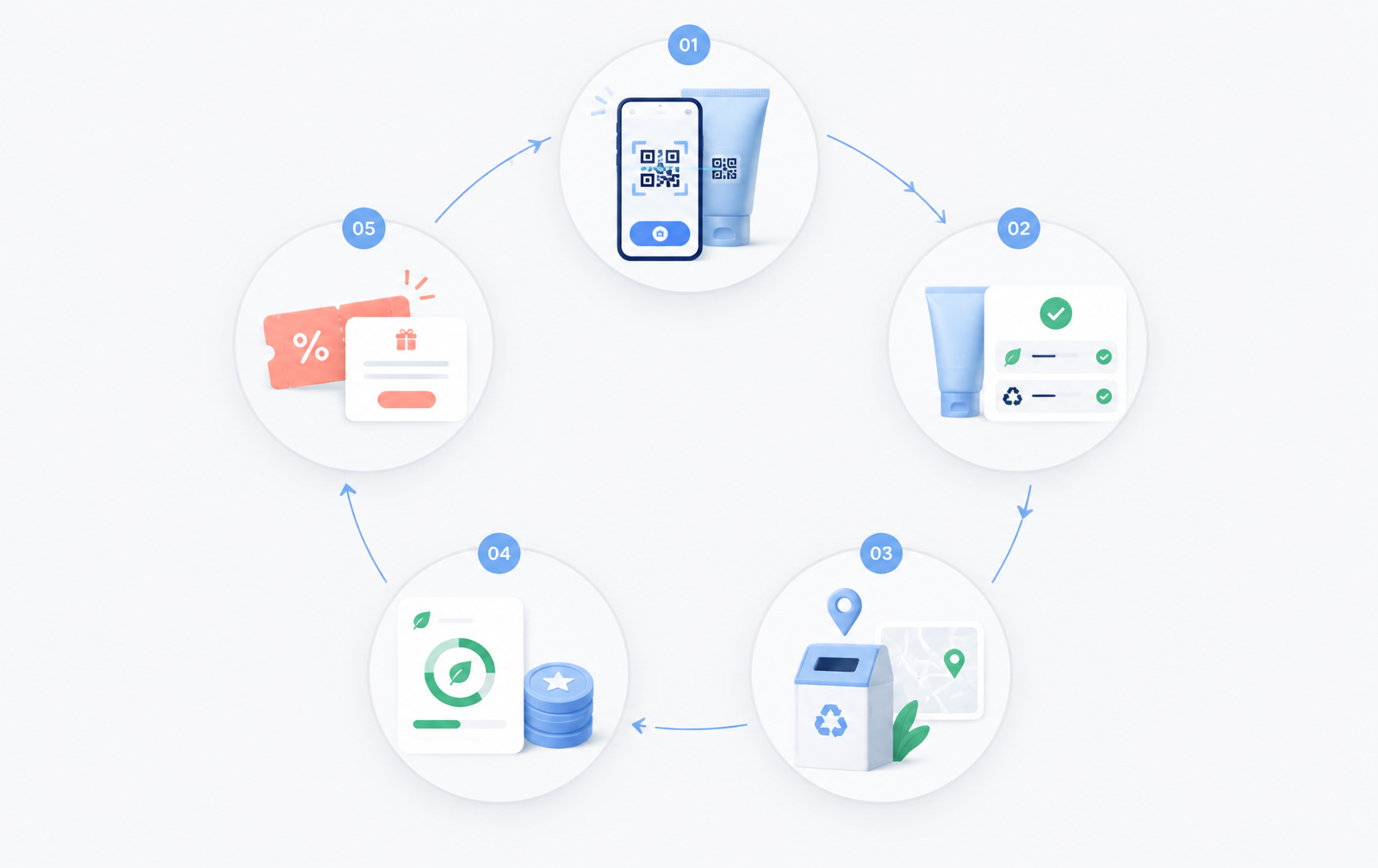
The service model connected operational verification with a simple consumer story: scan, return, see the impact, and receive value.
Customer validation prototype
Final Product Experience
The final mobile prototype made each stage of the circular service visible, guiding users from their first scan to an ongoing relationship built around impact and rewards.
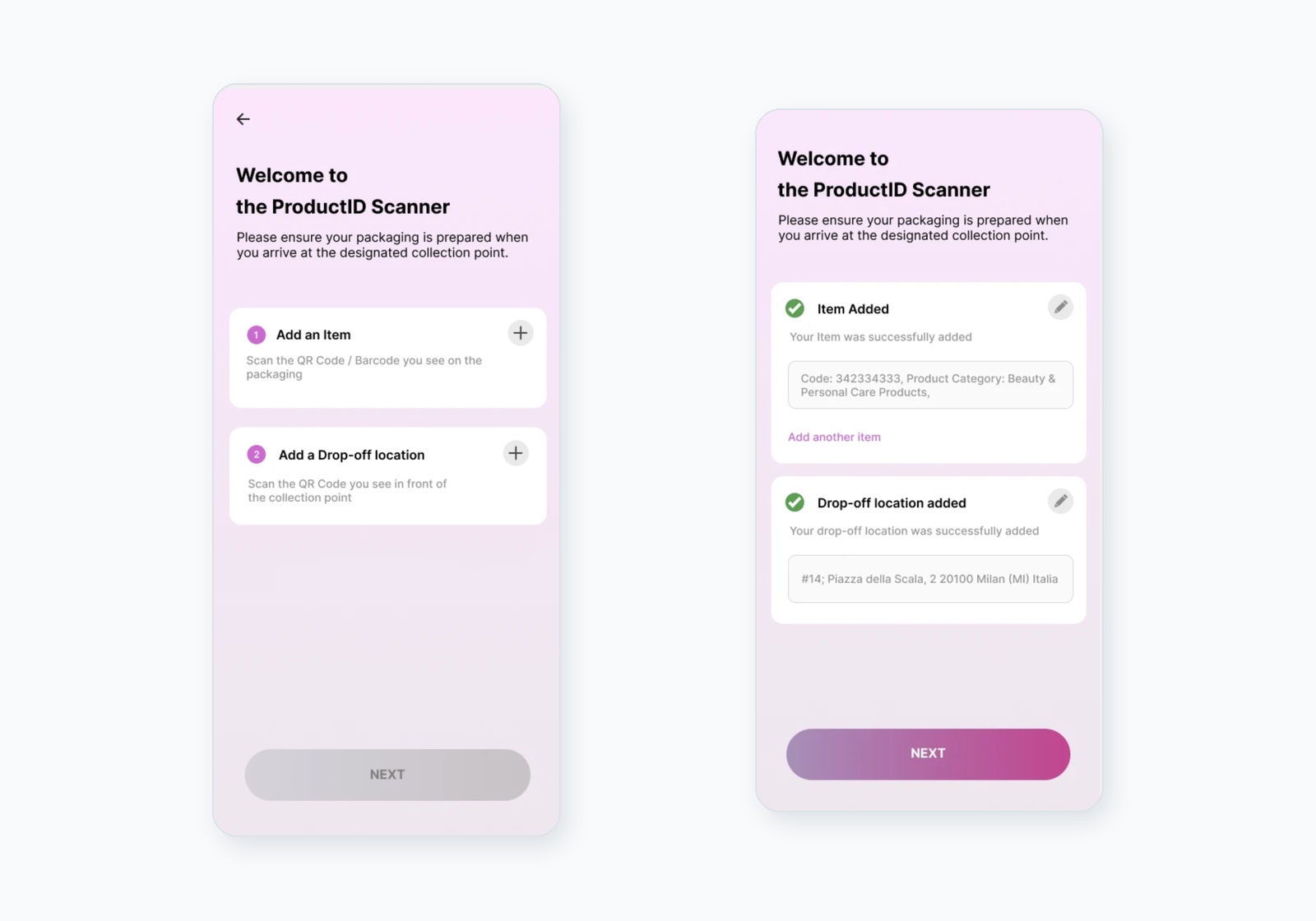
A guided return at the collection point
The scanner separates product identification from drop-off validation, then makes completion states explicit before the user continues.
- ✓Two-step physical validation
- ✓Editable completion states
- ✓Clear progression at the point of action
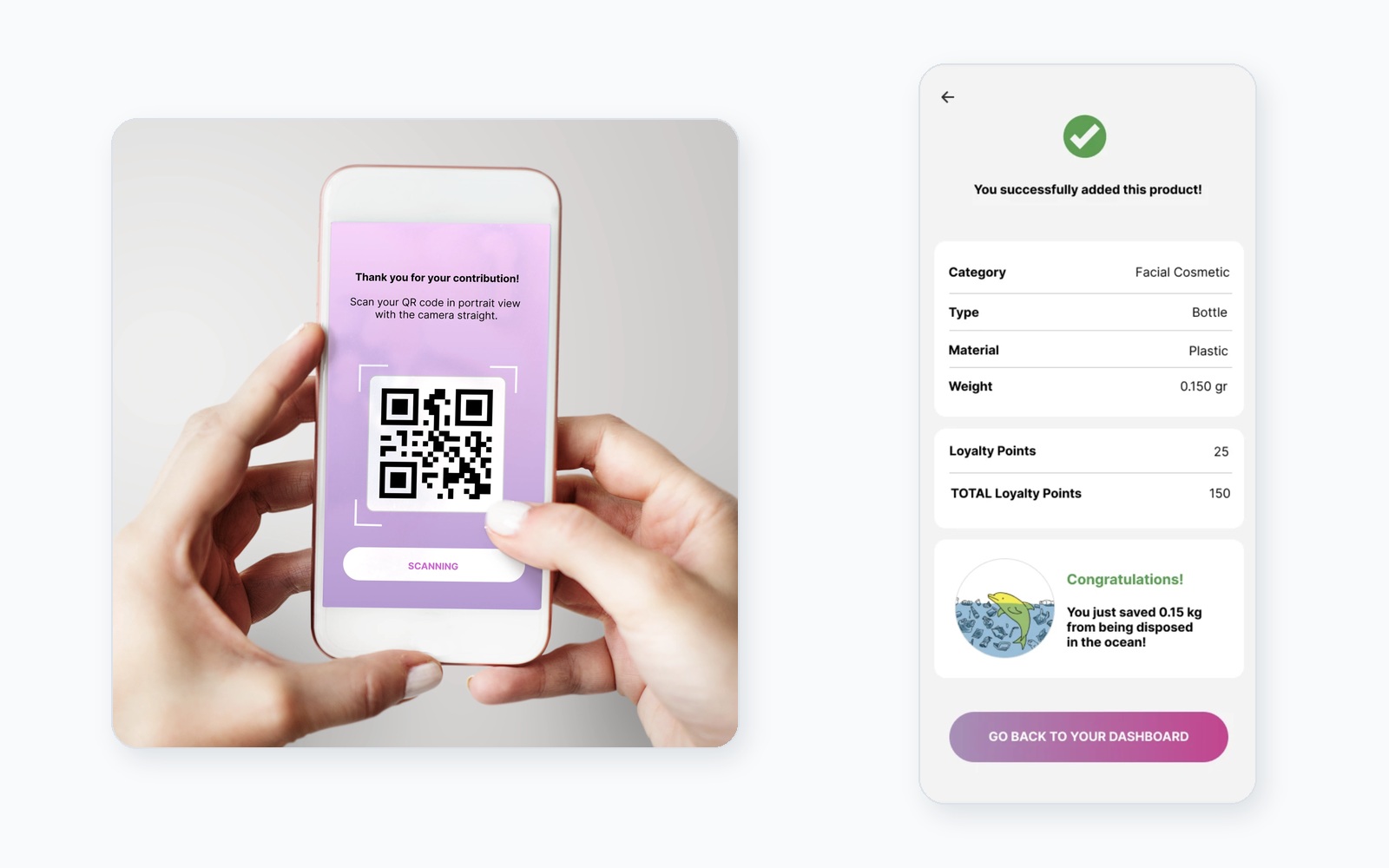
Immediate proof of contribution
After a successful return, the experience confirms the recognised packaging, points earned, updated total, and environmental contribution in one moment.
- ✓Transparent product attributes
- ✓Visible points calculation
- ✓Impact translated into understandable weight
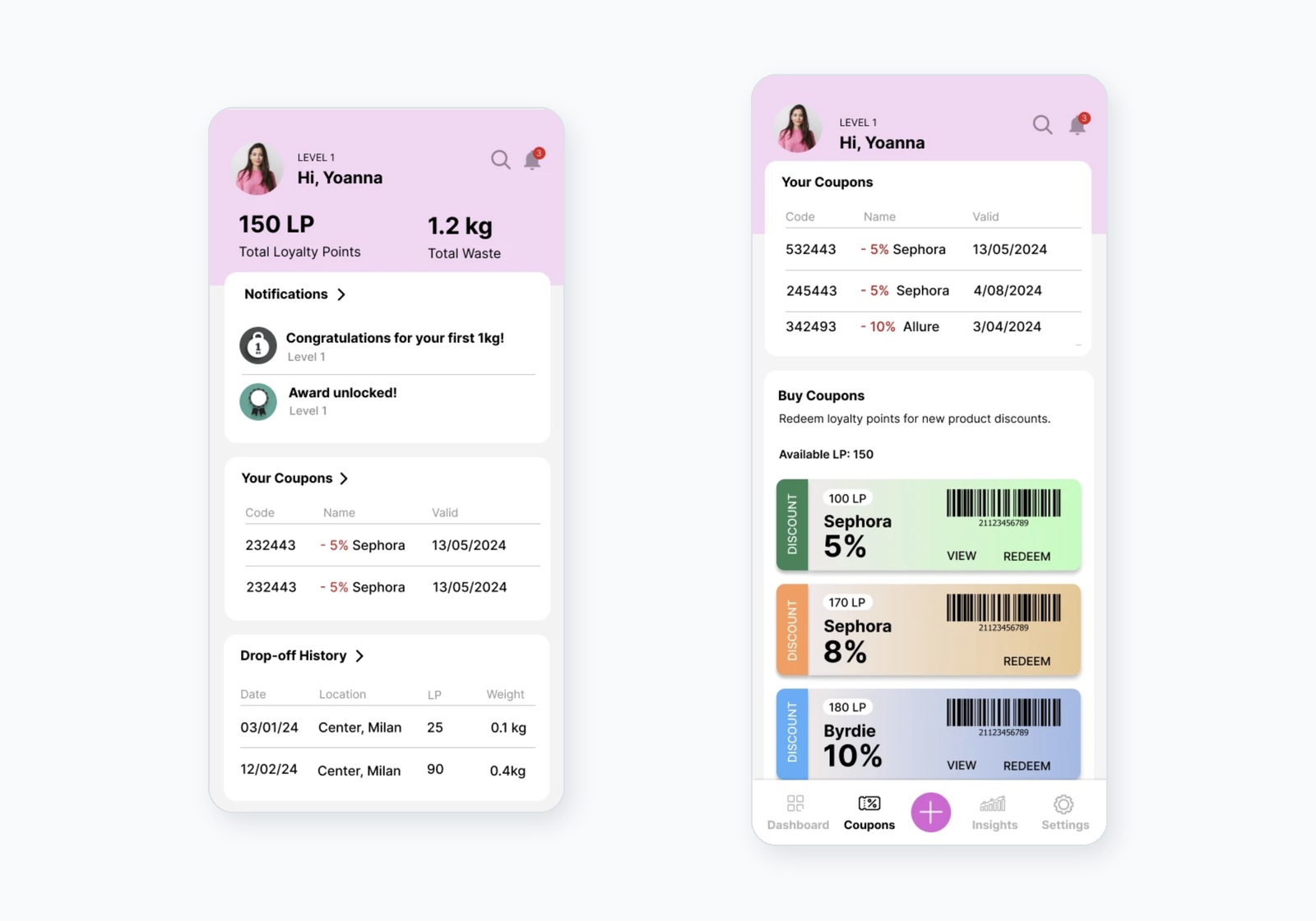
Progress and rewards that encourage return
The dashboard brings together loyalty balance, diverted waste, milestones, return history, and available coupons so users can see cumulative value.
- ✓Personal impact remains visible
- ✓Milestones reinforce continued behaviour
- ✓Partner coupons complete the value exchange
Role & ownership
Our Contribution
End-to-end product leadership — from discovery and strategy through workflow definition and delivery support.
Business outcomes
What Changed
The project transformed a complex circular-economy concept into a clear mobile experience and a practical business hypothesis the startup could test with customers and ecosystem partners.
Lessons & principles
Strategic Takeaways
Sustainable behaviour needs immediate feedback
Long-term environmental value becomes more motivating when each individual action produces a clear and credible result.
Rewards need operational integrity
Incentives are commercially useful only when the system can verify what happened before issuing value.
Service design extends beyond the screen
The quality of the experience depends on packaging data, physical collection points, partner rules, and waste operations working together.
A strong MVP proves the loop
For a multi-party startup, the first product should validate the complete exchange of action, impact, and value before expanding features.
Turning a complex service idea into a testable product?
The strongest MVPs connect customer motivation, operational reality, and commercial value in one coherent experience.
We help teams define the service logic, product priorities, and customer journey needed to move from ambition to credible validation.
No long-term commitments. No generic frameworks. Just clear direction.