Investment Platform • Market Strategy • MVP • Experience Design
Opening a new market through a beginner-first investment platform
A financial services company wanted to enter a new market and attract beginner investors. The challenge was not simply to launch another trading interface, but to identify a credible market position and turn it into an experience people could understand, trust, and use with confidence.
- ✓Defined a differentiated proposition for beginner investors
- ✓Converted market evidence into a focused MVP scope
- ✓Connected goal setting, portfolio creation, and progress tracking
- ✓Created a strategic foundation for staged market entry
Financial services company launching an internal venture
Enter a crowded investment market with a credible offer for beginners
Market research, product strategy, feature definition, UX architecture
A validated beginner-first proposition and focused investment MVP
Outcome first
Business Outcomes
The initiative was framed as a market-entry decision, not a feature exercise. Research had to show where the business could compete before design and delivery investment increased.
Reduced market-entry uncertainty
European competitor and feature analysis replaced assumptions with evidence about established patterns, underserved needs, and credible points of difference.
Focused investment on a clear segment
The proposition centred on beginner investors whose need for guidance, confidence, and control was not well served by complex wealth products.
Protected the MVP from feature inflation
Every capability was assessed against the target journey, allowing the team to separate launch essentials from later portfolio expansion.
Created a platform for staged growth
The resulting product model supports a clear first release while leaving room for broader investment products and more advanced users.
The business problem
The Challenge
The company saw an opportunity to reach a younger, less experienced investment segment, but the European market already contained digital banks, brokers, robo-advisors, and established wealth platforms.
Without a clear segment proposition, the initiative risked becoming an expensive collection of familiar features with no compelling reason to switch or start investing.
The business needed to understand which expectations were now market standards, where beginner needs remained underserved, and which feature set could support a credible first release.
"The opportunity was not to offer more investment options. It was to make the first investment decision feel understandable and achievable."
Many established products already covered trading, portfolios, and automated investment.
The internal concept lacked a defendable reason for the target segment to choose it.
Complex terminology, risk, and too much choice created friction before the first investment.
Building before validating the proposition could lock significant budget into the wrong scope.
Framing
Discovery & Product Definition
Discovery combined a review of leading European investment and wealth products with a feature-gap analysis focused on the full beginner journey — from intent and confidence to portfolio setup and ongoing progress.
Beginner investors did not need a simplified trading terminal. They needed a guided system that connected a personal goal, an understandable plan, and visible progress.
This shifted the product strategy from broad investment access to confidence-building automation with meaningful user control.
European Market Review
Compared leaders across digital banking, brokerage, robo-advice, and wealth management.
Feature Gap Analysis
Mapped how competitors supported discovery, planning, product choice, funding, and portfolio monitoring.
Segment Opportunity
Identified confidence and guided decision-making as the strongest opportunity for beginner investors.
MVP Prioritisation
Selected the capabilities required to prove the proposition without recreating a full wealth platform.
Product strategy
Key Product Decisions
The MVP was shaped by a small set of strategic choices that translated the target segment's needs into a coherent product position.
Start with goals, not financial products
New investors are more comfortable expressing what they want to achieve than selecting funds, instruments, or allocation models.
- ✓Creates a familiar entry point
- ✓Reduces choice overload
- ✓Connects investment decisions to personal intent
Make automation understandable
Automation reduces effort only when users can see what the platform is doing, why assets were selected, and what they can change.
- ✓Builds trust before funding
- ✓Keeps users in control
- ✓Makes allocation logic easier to explain
Design one continuous investment journey
Research, planning, allocation, funding, and progress are often fragmented across products. Connecting them removes the gaps where beginners lose confidence.
- ✓Clear path to first investment
- ✓Less context switching
- ✓Stronger continuity after onboarding
Use the MVP to test the proposition
The first release needed to validate beginner demand and behaviour before the business expanded the product catalogue or advanced tooling.
- ✓Lower initial delivery risk
- ✓Evidence for future investment
- ✓Clear boundary between MVP and later releases
System design
Defining the Solution
We defined a beginner-first investment journey that turns an abstract intention into a portfolio the user can understand, fund, and monitor.
Define a Goal
Set the Plan
Build Allocation
Start Investing
Track Progress
A continuous path from investment intent to an active, understandable portfolio.
Validating the workflow
Exploring the Experience
The experience direction emerged from a structured review of leading European investment and wealth-management products. We compared the same stages of the beginner journey, exposed feature and confidence gaps, and used those findings to define the market opportunity and minimum feature set.
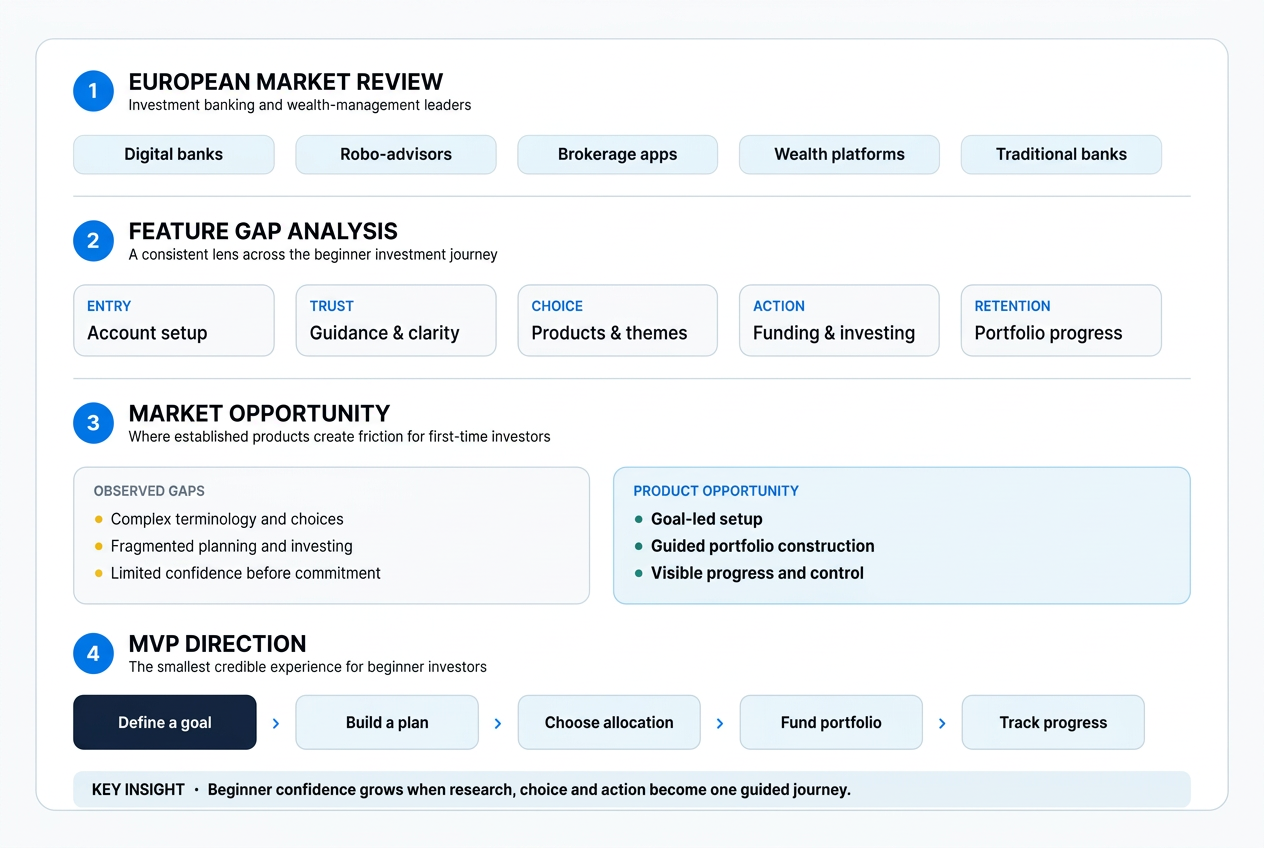
The analysis translated a broad market scan into a focused proposition: goal-led setup, guided portfolio construction, visible automation, and clear progress for beginner investors.
In the product
Final Product Experience
The final concept demonstrates how the proposition works as one connected mobile experience. Users move from a personal goal to a diversified plan, understand the projected outcome, and retain visibility and control after investing.
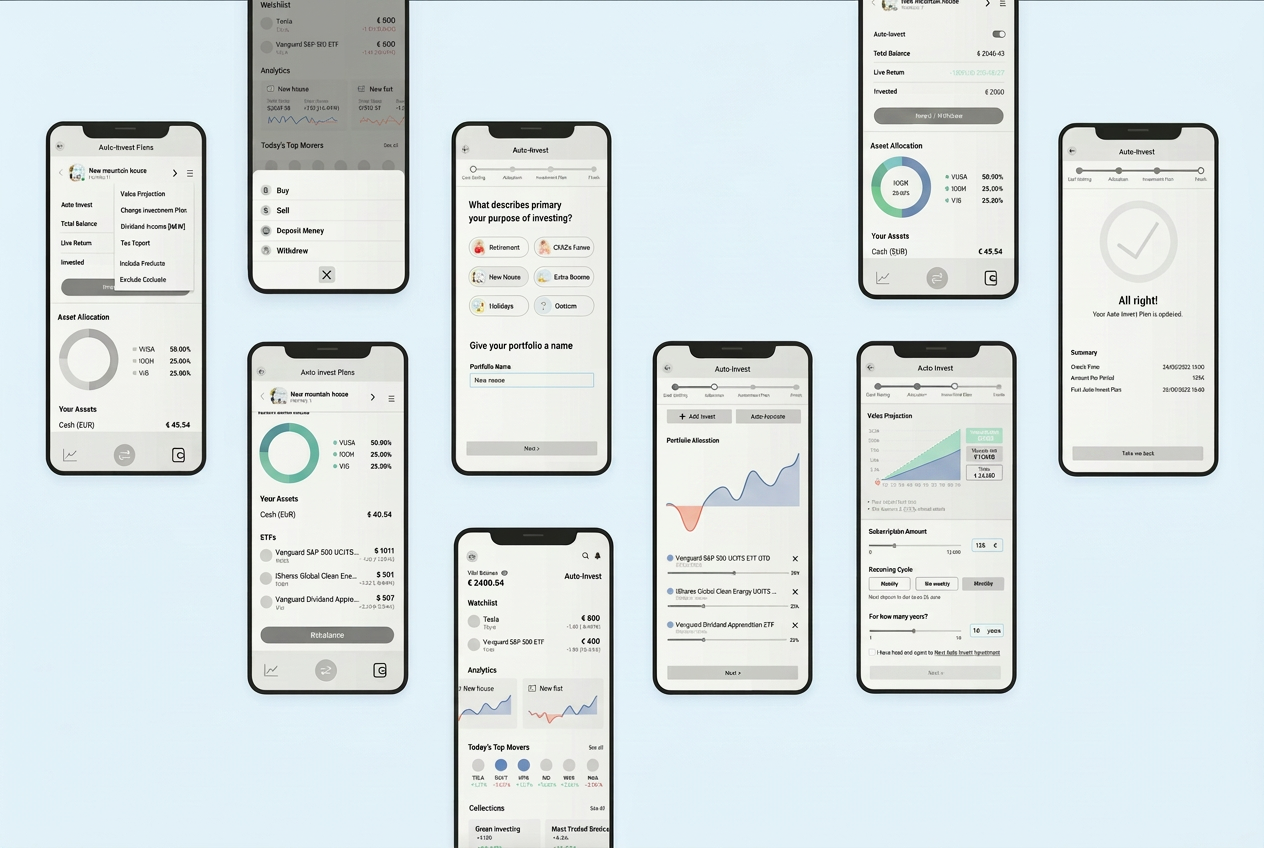
A complete journey, designed as one system
The prototype connected portfolio discovery, goal setting, allocation, projected value, and plan management rather than treating each capability as an isolated feature.
- ✓Consistent navigation across core investment tasks
- ✓Progressive disclosure keeps each step focused
- ✓Plan status remains visible after setup
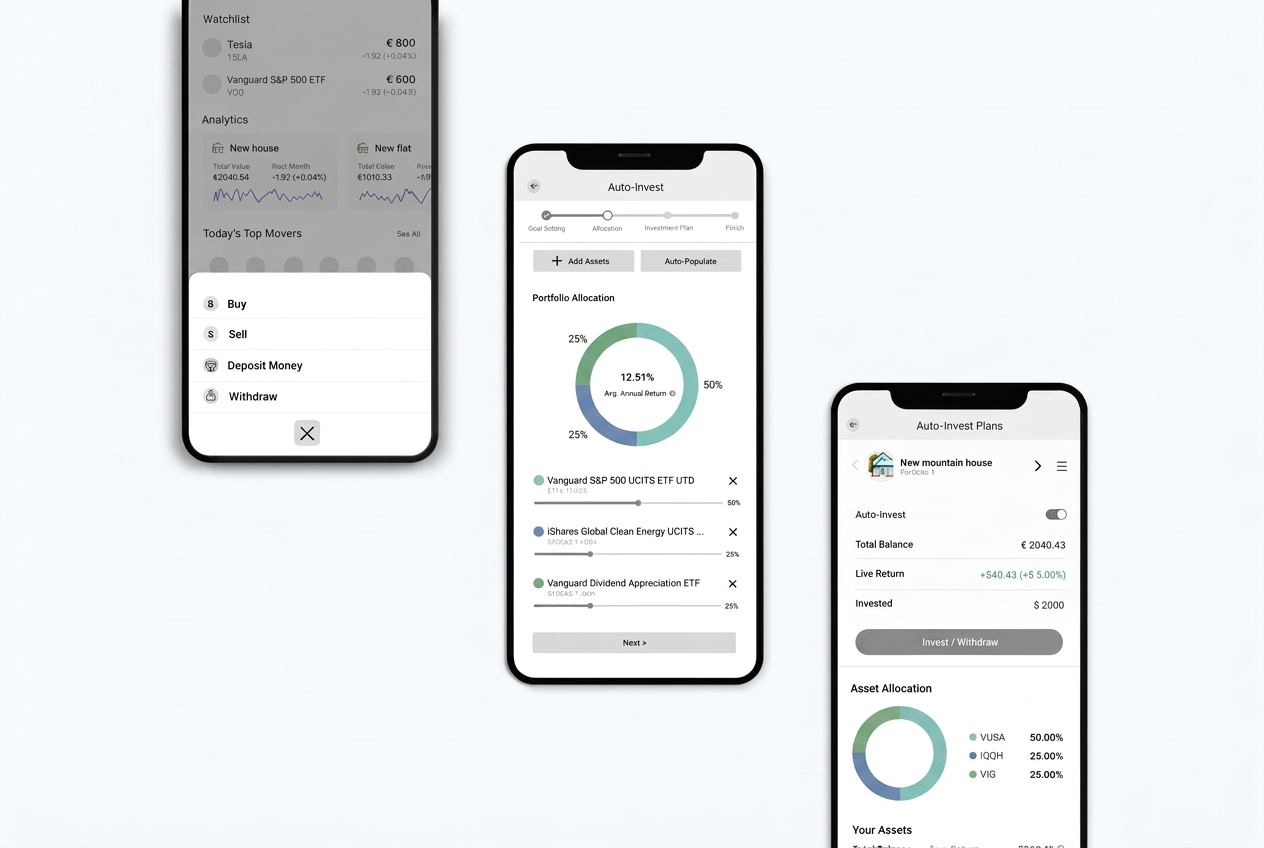
Guided portfolio creation with meaningful control
A step-by-step plan builder helps users define an allocation and understand its structure. Automation provides a starting point while editable assets and percentages preserve agency.
- ✓Visual allocation supports comprehension
- ✓Auto-population reduces the blank-state problem
- ✓Users can adjust the portfolio before committing
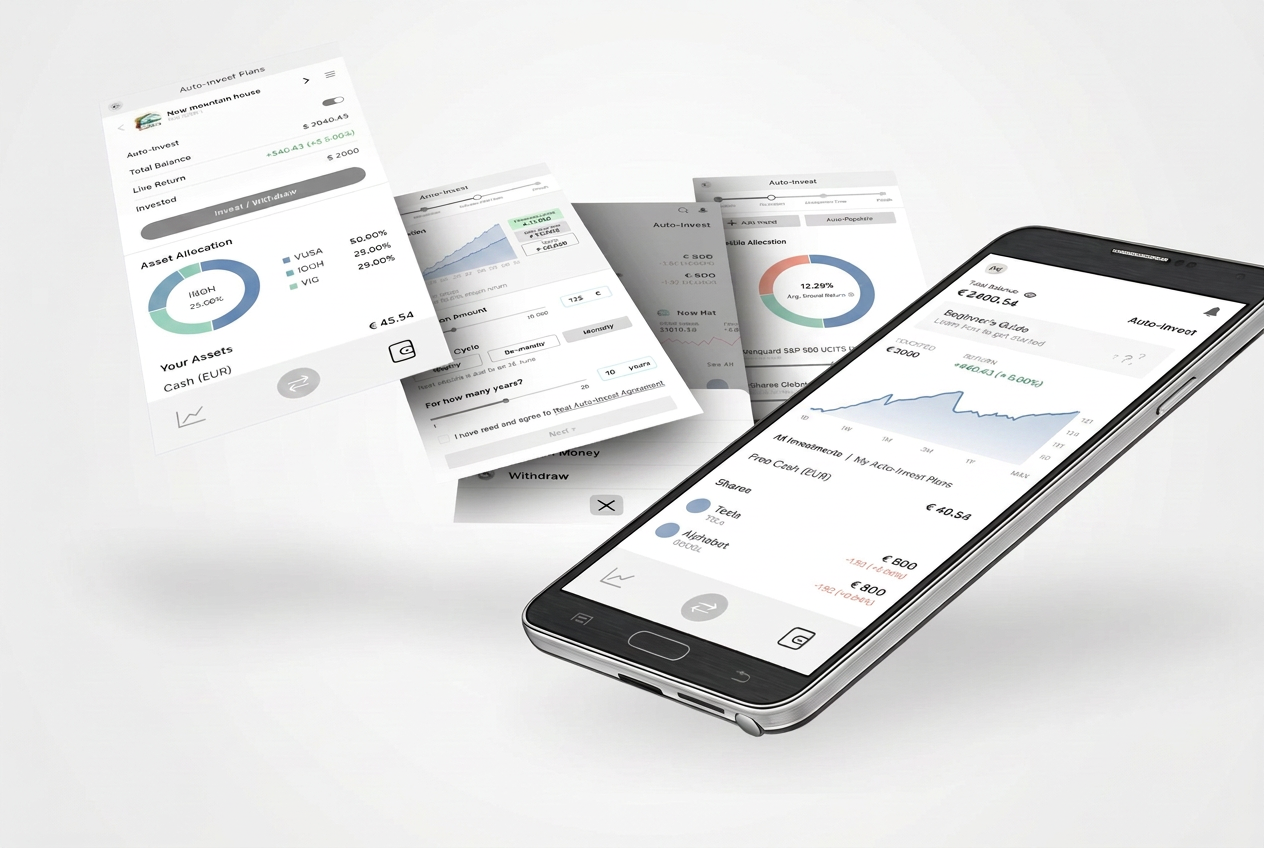
From first investment to visible progress
The portfolio view brings invested value, returns, available cash, and plan performance into one understandable place, creating continuity between the initial setup and ongoing engagement.
- ✓Performance is shown in plain, contextual language
- ✓Portfolio and individual assets remain connected
- ✓The interface supports the next action without overwhelming the user
Role & ownership
Our Contribution
End-to-end product leadership — from discovery and strategy through workflow definition and delivery support.
Business outcomes
What Changed
The initiative moved from an undefined ambition to a research-backed product direction, a coherent MVP, and a clear hypothesis the business could test in market.
Lessons & principles
Strategic Takeaways
Market entry begins with focus
A new platform does not win by matching every established feature. It needs a specific audience, an unresolved need, and a deliberate point of view.
Beginner simplicity is structural
Removing visual complexity is not enough. The product model must reduce decisions, explain consequences, and connect each step to the user's goal.
Competitor analysis should drive choices
Research becomes valuable when it changes the proposition, excludes low-value features, and clarifies where the experience must differ.
An MVP is a business experiment
The right first release proves demand and behaviour while protecting the organisation from premature platform expansion.
Exploring a new product or market opportunity?
The strongest MVPs begin with evidence about the audience, the market, and the business decision the product needs to validate.
We help teams turn strategic opportunities into focused propositions, coherent journeys, and investable product direction.
No long-term commitments. No generic frameworks. Just clear direction.